


Overview
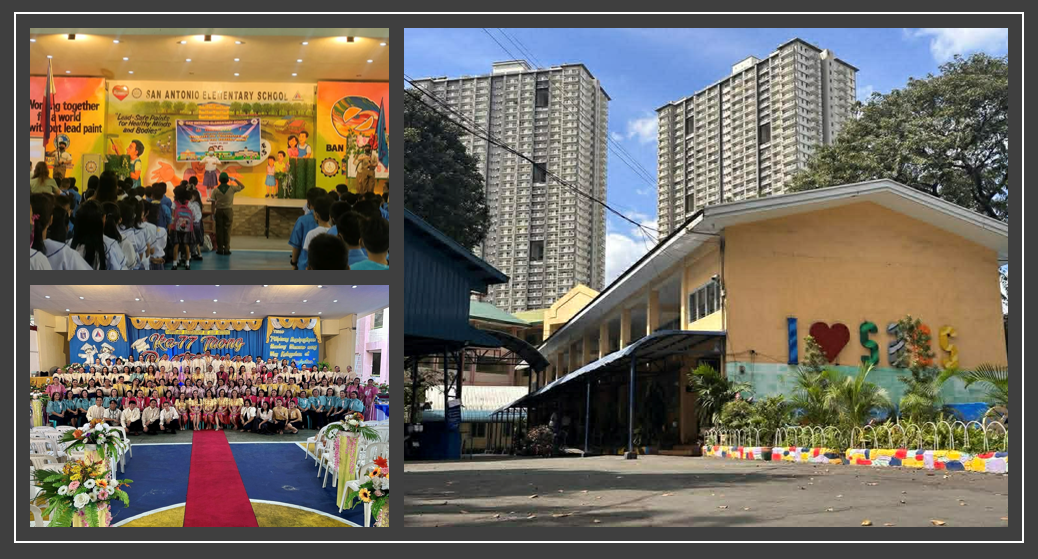
San Antonio Elementary School (SAES) traces its humble beginnings to the opening of the school year 1947. Before becoming a school, the site was once used as a slaughterhouse during the pre-war period and was known as the Matadero Annex. The school started with only two classroom teachers under the supervision of Mr. Dumlao.
The following year, due to the increase in enrollment, the school became an annex of Bonifacio Elementary School with eight teachers under the supervision of Mr. Cuartina.
Historical Timeline Infographic
 1947 – The Beginning
-
The school was established as Matadero Annex.
-
The site was formerly a slaughterhouse before World War II.
-
Started with two teachers under Mr. Dumlao.
 1948 – Expansion
-
Became an annex of Bonifacio Elementary School.
-
Enrollment increased, resulting in eight teachers under Mr. Cuartina.
 1955 – Reorganization of Annexes
-
Bago Bantay Elementary School (formerly Bonifacio Elementary School) managed the following annexes:
-
South Bago Bantay
-
Matadero Annex
-
Philcusa Annex
-
-
During the administration of Mr. S. Magturo, the Philcusa Annex separated and later became Esteban Abada Elementary School.
-
Matadero Annex only handled Grades I–IV, while the main school catered to intermediate grades.
 1958–1959 – Growth and Development
-
Enrollment increased, and the teaching force expanded to sixteen teachers.
-
Through the efforts of the PTA, a prefabricated building was constructed.
-
Grades V and VI were accommodated for the first time.
-
Congress passed a bill renaming Bago Bantay Elementary School to Esteban Abada Elementary School.
-
Matadero Annex was renamed San Antonio Annex, which later became an independent school named San Antonio Elementary School.
 1960–1965 – Infrastructure Expansion
-
Garcia Annex was established to accommodate the growing student population.
-
Additional prefabricated buildings were constructed through the efforts of the PTA and Teachers’ Club.
-
Mrs. Generosa Soriano led the expansion projects.
-
Under Mrs. Lorenza Ilagan, the following facilities were constructed:
-
Home Economics Building
-
Industrial Arts Shop
-
 Academic Excellence Era
Mrs. Agueda H. dela Rosa
-
Strengthened the school’s academic reputation.
-
Pupils began winning academic competitions.
Mrs. Emiliana M. Bancod
-
Continued academic excellence and school recognition.
Mrs. Norma R. Reyes
-
Led the construction of:
-
Eight-room Administration Building (opened March 20, 1983)
-
Filipino-Chinese Chamber of Commerce Building
-
-
The school excelled in athletics, journalism, and academics.
 Development Under Mrs. Zenaida R. Vasquez
-
Constructed:
-
Two-storey Aguinaldo Building (6 rooms)
-
Two-storey SEF Building (4 rooms)
-
-
Initiated the organization of SPED classes.
 Leadership of Mrs. Elizabeth San Diego
-
Motivated teachers and pupils toward excellence.
-
Pupils won championships in academic competitions.
-
Many teachers became outstanding and master teachers.
-
Two teachers qualified for DECS Scholarships in English and EPP.
-
Constructed the two-storey Cariño Building.
-
The school became classified as a P-III School with 65 teachers.
 Administration of Mrs. Adalia R. Alhambra
-
Maintained the school’s outstanding performance in academics and sports.
-
After her three-year term:
-
School population reached 2,550 pupils
-
Teaching force increased to 66 teachers
-
Improvements During Mrs. Lilia S. Recto’s Term
-
Continued excellence in competitions.
-
Constructed the SPED Building through the assistance of the late Congressman Reynaldo Calalay.
-
Added a covered court and renovated the school stage.
-
Acquired an additional lot from the city government.
-
School land area expanded from 9,500 sq.m. to 15,865 sq.m.
 Typhoon Ondoy
-
The school suffered severe flooding and damage to classrooms and materials.
-
Despite the calamity, reconstruction and improvements continued.
Additional Developments
-
Construction of:
-
Three-storey building beside Aguinaldo Building
-
Perimeter fence
-
SB Gate
-
Covered pathway from the covered court to Cariño Building
-
-
Renovation of Home Economics and Industrial Arts buildings
 2012 – Administration of Mrs. Wilma C. Manio
Mrs. Wilma C. Manio introduced major improvements to the school, including:
-
Repairs and refurbishment of school buildings
-
Construction of:
-
Bahay Kubos
-
Gazebos
-
SPTA Office
-
New Kinder Building
-
DPWH Four-Storey Building
-
-
Reconstruction of:
-
Administration Office
-
Home Economics Room
-
Canteen
-
-
Installation of murals and repainting of school walls
-
The school received the Brigada Eskwela Best Implementer Award (Small School Category, SY 2013–2014).
 2015 – Leadership of Dr. Teresita S. Dumpit
In January 2015, Dr. Teresita S. Dumpit became the school head and immediately initiated several improvements:
Major Accomplishments
-
Construction of covered pathways between buildings
-
Reconstruction and refurbishment of the canteen
-
Repositioning of tarpaulin displays
-
Redecoration of Bahay Kubos
-
Clearing of disposable materials in the school backyard
-
Relandscaping of school gardens
-
Repair of doors and windows in the social hall and administration office
-
Refurbishment and reconstruction of the computer room
 Present Day
San Antonio Elementary School continues to prepare for every school year by improving its facilities and programs to provide a safe, learner-centered, and conducive environment for all learners.
Legacy of Excellence
 From a former slaughterhouse to one of the recognized institutions in Quezon City, San Antonio Elementary School remains committed to excellence in academics, leadership, sports, and holistic learner development.